The sinking of the Principessa Mafalda
Off the Abrolhos, a nineteen-year-old liner full of emigrants went down in a few hours. She carried 1,259 people. Three hundred and fourteen never arrived.
- On board
- 1,259
- Dead
- 314
- The shaft breaks
- 17:15
- Where
- north-east of the Abrolhos
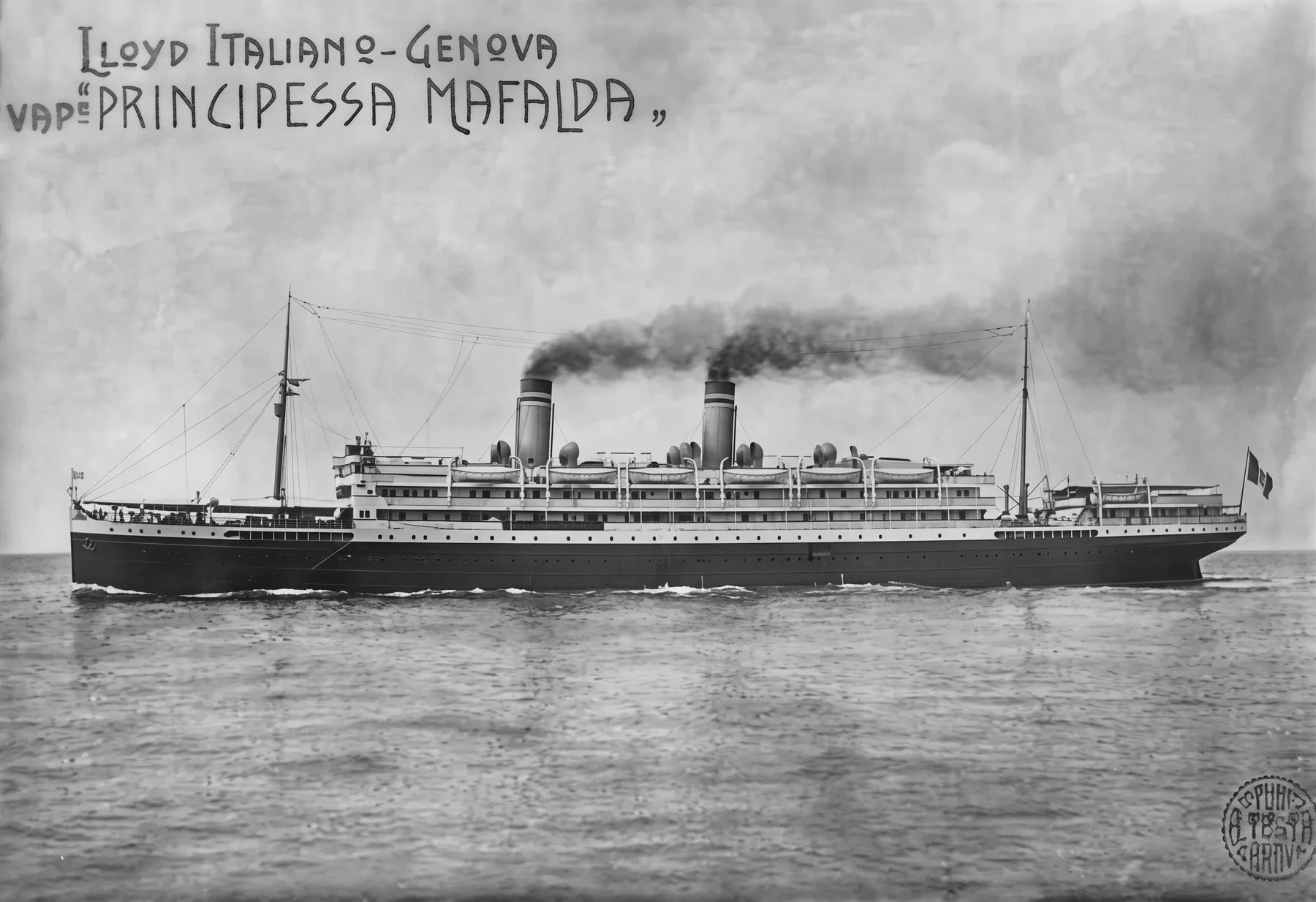
She exists because of an accident.
Lloyd Italiano ordered two identical ships. The first, the Principessa Jolanda, went down the slipway at Riva Trigoso in September 1907 with her engines and boilers already on board, heeled over in front of the spectators and sank. No one died.
The second was launched the following year in a different way: without funnels or superstructure, which were fitted once the hull was already afloat. She was named after the second daughter of King Vittorio Emanuele III, a girl not yet six.
- Shipyard
- Riva Trigoso, Liguria
- Owner
- Lloyd Italiano, later NGI
- Launched
- 1908
- Gross tonnage
- 9,210 GRT
- Route
- Genoa – Buenos Aires
- Crossings
- about ninety
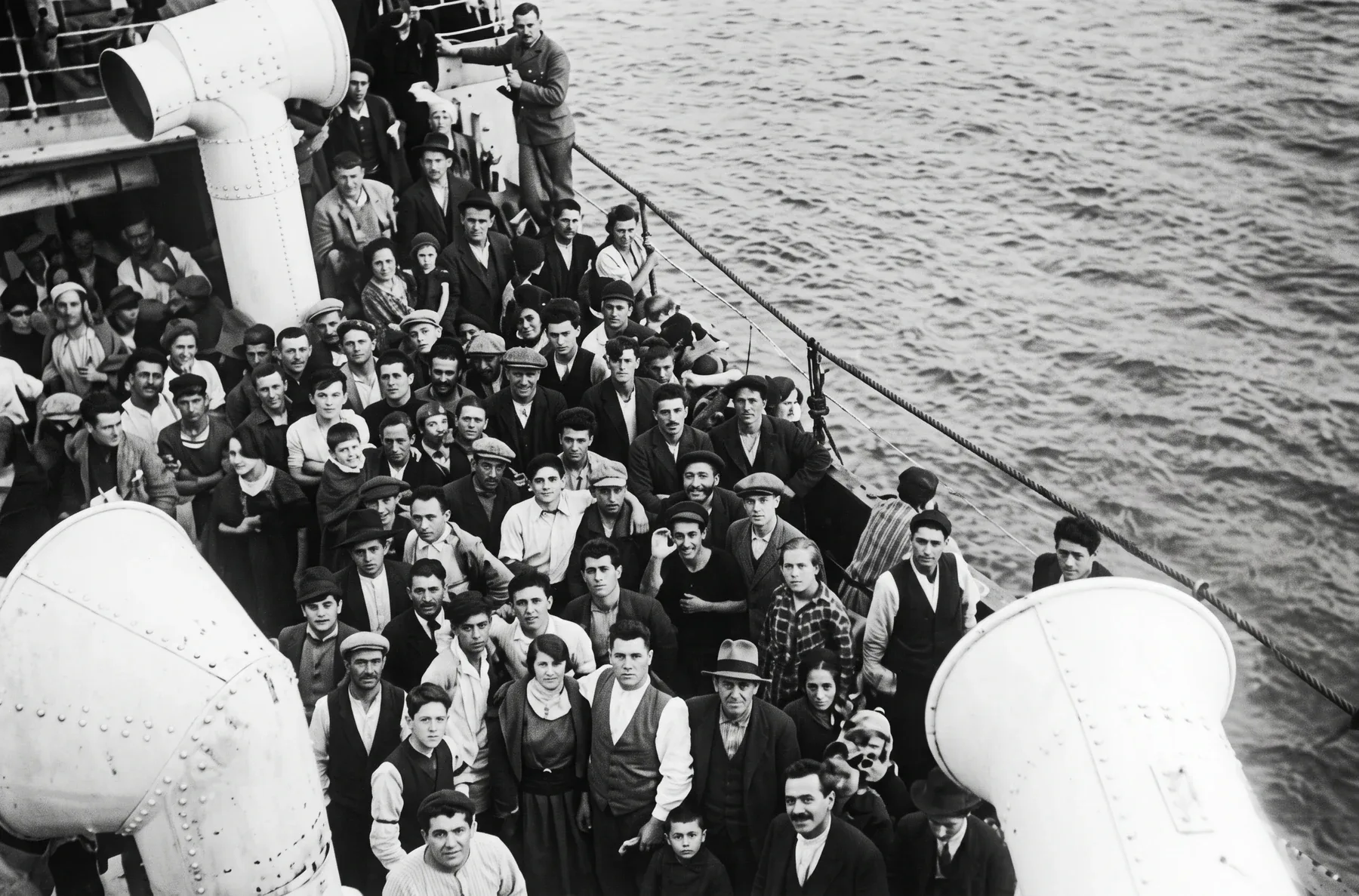
Fifty-two people in first class. Eight hundred and twenty-seven in third.
That was the split on the last voyage, according to the passenger list a Recife newspaper printed two days after the sinking. Above, saloons, a grand staircase and cabins. Below, shared dormitories.
There are photographs of the first-class saloons. Of third class there are almost none: the upper deck became pictures; the lower deck became testimony, and only after she sank.
An old ship on a voyage that went wrong from the start.
The pride of Lloyd Italiano in 1908 was, by 1927, a nineteen-year-old ship, outclassed by newer liners, running the Genoa–Buenos Aires route almost entirely with emigrants.
She left Genoa on 11 October, late — a third-class passenger remembered twenty-seven hours, because the ship had arrived already in trouble. She called at Barcelona. The usual African stop was Dakar, but there was cholera in the city, so she went to Mindelo, on the island of São Vicente, in Cape Verde.
From there, according to the historian Stefan Ineichen’s research and the 1927 newspapers, Captain Simone Gulì cabled Genoa about the state of the ship. The reply was an order to carry on. The Mafalda left São Vicente on 18 October. By the eve of the sinking the passengers could already feel her listing.
Hour by hour
The times of this shipwreck do not agree from one source to another. In 1927 each ship kept its own clock, set by longitude, and the telegrams reached Europe two hours ahead. The times below are those of the sources given; the end of the ship was recorded anywhere between 20:45 and 23:30.
- 15:50
The Dutch cargo ship Alhena crosses paths with the Principessa Mafalda and overtakes her. Hours later, she will pick up more people than any other ship.
Report by the Alhena’s captain - 17:15
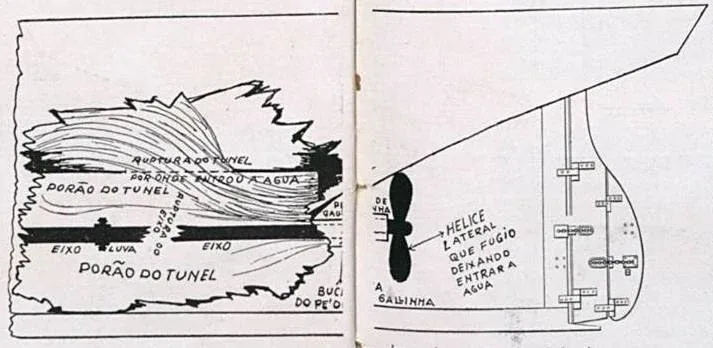
Off the coast of Bahia, the port propeller shaft breaks and slips out. Water pours in at the stern.
Time used in the book; the telegrams give 19:15, the same moment in European time - ≈ 17:30
First distress call. The Mafalda’s wireless operator tells the Avelona there is a breach at the stern letting in an enormous amount of water.
Log of the Formosa; Avelona, via the press - 18:15
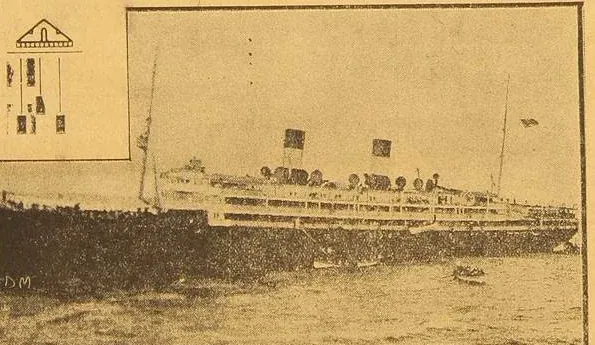
From the deck of the Alhena, someone photographs the ship. Two lifeboats are already in the water.
Diário da Manhã, 30.11.1927 - 18:19
The sun sets. Twilight ends at 18:41. From then on, everything happens in the dark.
Astronomical calculation for 17°45′ S, local solar time - 19:00
The Mafalda herself radios that there is no longer any electricity on board. From now on she speaks through the emergency sets.
Radiotelegram from the Massilia, Diário da Manhã, 28.10.1927 - 20:00
The ship tells the French Formosa that she still has five hundred people on board and no lifeboats.
Journal of the Formosa’s captain, A Tribuna, 31.10.1927 - 20:45 – 23:30
The Principessa Mafalda sinks stern first. Each ship standing by recorded a different time. Captain Simone Gulì stayed on board.
Formosa, Avelona, Alhena and survivors - Small hours
The rescue ships keep pulling people from the water. Some survivors stay afloat for eight hours before they are found.
Survivors’ accounts
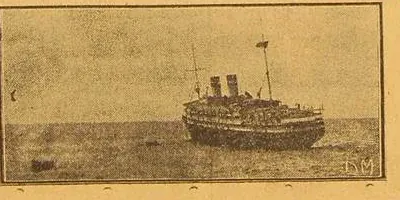
Photographs taken from the deck of the Alhena and published by the Diário da Manhã, Recife, on 30 November 1927 as “never before seen by the Brazilian public”. Hemeroteca Digital Brasileira.
Where the ship went down
There is no single position. The distress call went out with one set of coordinates, the log of the French ship that heard it recorded another, the press printed a third, and the wreckage was sighted days later further south, near the Abrolhos — the captain had tried to head for land. The map shows them all, each with its source.
- 16°48′ S · 37°41′ W — Position of the distress call, as the telegrams published it. Diário da Manhã, Recife, 27.10.1927
- 16°59′ S · 37°51′ W — Position of the distress call in the log of the French ship Formosa. A Tribuna, Santos, 31.10.1927
- 17°35′ S · 37°49′ W — The Formosa’s position, in O Malho’s version. O Malho, Rio de Janeiro, 5.11.1927
- 17°45′ S · 38°11′ W — Where the ship Saint Anthony sighted the wreckage, about 60 km north-east of the Abrolhos. Diário da Manhã, Recife, 12.11.1927
The lifeboat, meant to save them, was for many the way into the water.
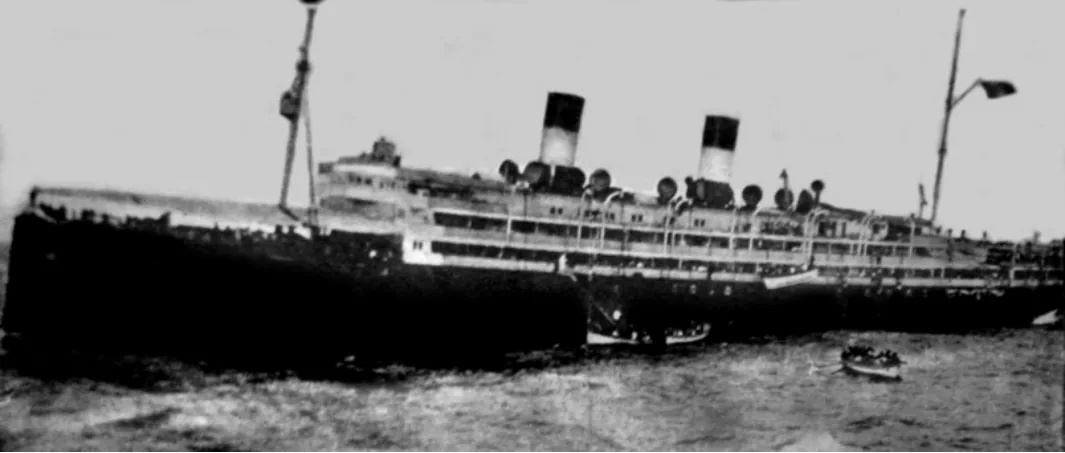
Read the survivors’ accounts together and a pattern emerges: of the twelve Mafalda lifeboats that can be identified in the testimonies, only one arrived in good order.
The others capsized from overcrowding, were lowered crooked, had their ropes snap or were abandoned. One survivor said her boat fell when it was thirty centimetres from the water. The rafts nearest second class, at the stern, were jammed by heavy ventilators that no one could shift.
There was panic and there was violence. Georges Grenade, a first-class passenger, wrote to his wife the next day that a man’s hand had become trapped between the pulley and the rope of a lifeboat, and that a crewman cut through his wrist with a knife to free the rope. The same letter records seven hundred emigrants throwing themselves at the boats.
And there were those who went back. A third engineer who had saved himself returned to fetch two more. The rule of women and children first did exist — a third-class girl remembered the captain shouting le donne e i bambini — but it did not rule the night. It ruled a few boats, for a few minutes.
The ships that stopped
The distress call was heard by at least ten ships. Those that arrived in time spent the night picking people up. The Alhena anchored twelve metres from the Mafalda and ran a rope from stern to bow; three survivors say, each independently, that they were saved by clinging to it. Children were hauled up to the cargo ship’s deck in sacks, pulled by sailors up the rope ladders.
The times survivors spent in the water range from an hour and a half to eight hours. Some spent the night on a plank with others, and at dawn found fewer people around them. Several accounts mention sharks.
Six people died after being rescued, four on board the Mosella and two on the Rosetti. They were buried at sea. On the Mosella the burial took place at nine in the morning on the 26th.
| Ship | Rescued | Landed at |
|---|---|---|
| Alhena Dutch | 530 | Rio de Janeiro, Ilha das Flores |
| Formosa French | 380 | Rio de Janeiro |
| Mosella French | 32 | Salvador |
| Rosetti | 27 | Recife |
| Total | 969 | + 312 dead = 1,281 |
It is the only 1927 count that adds up. Even so, it leaves out the Empire Star, which also picked up survivors.
The blame kept changing target, and always moved downwards.
The Italian survivors were ordered not to criticise the ship or say anything that might harm Italy’s image. The sinking came in the week of the fifth anniversary of the March on Rome. In Rio the Italian ambassador kept the press off the Alhena’s gangway; in São Paulo reporters ran into obstacles at the Hospedaria.
It was said that Captain Gulì died shouting Viva l’Italia. No survivor witnessed the words: the press put them in his mouth. From a boat of the French ship, someone saw him with his cap in his hand, giving three blasts of the whistle.
The Italian inquiry, concluded on 31 January 1928, found the lifeboats to be in excellent condition, blamed the chief engineer and passengers who did not know how to use a life jacket, and called the cooks and stewards an obstacle to the rescue. It also declared itself unable to give an opinion on the responsibility of the owners.
- 1a mine from the Great Waraccording to the company, in Buenos Aires
- 2third class, supposedly storming first classaccording to a Recife newspaper
- 3“the Syrian element”according to an Italian quoted by the press
- 4the passengersaccording to the Italian ambassador in Rio
- 5the crewaccording to the newspaper La Prensa, Buenos Aires
- 6“three hundred Moroccan passengers”according to survivors interviewed in Rome
- 7no oneaccording to the official inquiry, in 1928
How many there were, how many died
There is no official list of the dead. The Genoa embarkation list has never been found. Every count, in 1927 and today, gives a different number, and the difference is part of the story: the figures coming out of Italy started low and rose, those from abroad started high and fell, and the two met in the middle without anyone having counted a single body.
| Source | On board | Dead |
|---|---|---|
| Plaque at the Galata Museo del Mare, Genoa (2012) | 1,259 on board | 314 dead |
| Survey by Campodonico (2014), via Ineichen | 1,255 on board | 324 dead |
| O Malho, Rio de Janeiro, 5.11.1927 | 1,281 on board | 312 dead |
| Diário da Manhã, Recife, 27.10.1927 | 1,208 on board | “only 68” missing |
| Corriere della Sera, 28.10.1927 | — | 34 dead |
| Captain of the Mosella, on arrival | — | about 600 dead |
By class
By the count the historian Stefan Ineichen reproduces, eleven in every hundred crew members died, twenty-eight in every hundred third-class passengers, forty-eight in first class and sixty-one in second. Two other counts put first class at around fifty-five per cent and second at around thirty-nine.
In all of them, third class lost the fewest passengers — the opposite of the Titanic. Not through anyone’s virtue: the water came in at the stern, where second class was, and the night was decided in the water, not in the boats.
Where they were going
According to the passenger list published in Recife two days later, of the third-class passengers nine were to land in Rio, fifty-nine in Santos, and seven hundred and fifty-nine were going on to Buenos Aires. Most were Italian; the embassy also counted a hundred and eighteen Syrians, fifty Spaniards and thirty-eight Yugoslavs.
“Anyone who ventured today to speak of the sinking of the Principessa Mafalda (…) It is a subject that has sunk for ever.”
Diario Nacional, São Paulo, fourteen months later
In 2012, on the 85th anniversary, a plaque at the Galata Museo del Mare in Genoa remembered the dead and wrote down what Italy had kept silent for decades: that the disaster had long been hidden by the responsibilities of the Fascist regime and the shipping company.
The shipwreck in brief
When and where did the Principessa Mafalda sink?
On the night of Tuesday, 25 October 1927, in the Atlantic Ocean off the coast of Bahia, north-east of the Abrolhos archipelago. The ship was on the Genoa–Buenos Aires route, with scheduled calls at Rio de Janeiro and Santos.
How many people died in the sinking of the Principessa Mafalda?
The figure declared by the shipping company, and engraved on the plaque at the Galata Museo del Mare in Genoa, is 314. Other counts give between 312 and 324. In the first days, newspapers reported anything from 34 to about 600 dead. There is no official list of victims; the list circulating among descendants has 311 names.
How many people were on board?
1,259, according to the Genoa plaque: 971 passengers and 288 crew. Another count gives 1,255. Most were travelling in third class, as emigrants.
Why did the Principessa Mafalda sink?
At around 17:15 on 25 October, the port propeller shaft broke and slipped out, opening the stern to the sea. The ship was nineteen years old and had suffered a series of breakdowns on the same voyage. The Italian inquiry of 1928 blamed the chief engineer and gave no opinion on the company’s responsibility.
Which ships rescued the survivors?
Mainly the Dutch cargo ship Alhena, which picked up about 530 people and landed them in Rio de Janeiro, and the French Formosa, with about 380. The French Mosella, the Rosetti and the Empire Star also picked up survivors.
Where were the passengers going?
Most to Buenos Aires. According to the passenger list published in Recife two days later, of the third-class passengers nine were to land in Rio de Janeiro, fifty-nine in Santos, and seven hundred and fifty-nine were going on to Argentina. There were Italians, Syrians, Spaniards, Yugoslavs and others.
What happened to the captain?
Captain Simone Gulì stayed on board and died in the sinking. The words “Viva l’Italia”, which the press attributed to him, were not witnessed by any survivor.
Where can I find the names of the victims?
On this page, in the In memoriam section, with a name search. The list is a compilation that circulates among descendants, with no known official origin, and keeps the spellings as they were copied.
Those who never arrived
This list has 310 names. It has circulated among descendants for decades, in compilations that copy one another, and none of them says where it came from: it is neither an archival document nor an official list. It is what is left. The names are as they were copied, with the spellings and ages of whoever first wrote them down — in this story, a name was almost never written the same way twice. One name has been removed: Maiotta, Enrico, a baby a few months old, is Enrico Miotto, who survived and appears on the same list among the saved.
205 of these 310 were travelling in third class.
No name found. Try another spelling.
Crew 37
- Ambrosio, Giovanni
- Antonini, Luis
- Azzeta, Daniel
- Baldrachi, Luis
- Balsamo, Aniello
- Bonanno, Salvador
- Buenaventura, Gennaro
- Calamatti, Hugo
- Calessi, Antonio
- Castrucci, Luciano
- Colla, Josefina
- Delvigo, Giuseppe
- Dimichini, Ubaldo
- Elcarti, Francesco
- Falcidione, Carlo
- Figarelli, Camilo (Ship doctor)
- Gardifiglia, Benito
- Gioffi, Giuseppe
- Guli, Simon (Captain)
- Home, Ana
- Luzzatti, Silvio
- Macchio, Camilo
- Montaiutti, Giovanni
- Moresco, Francesco (OE)
- Neabona, Vicente
- Pezzearonna, Pietro
- Puppo, Natalio
- Relicatti, Juan
- Reschia, Francisco
- Scarabichi, Silvio (First Engineer)
- Spalazi, Armando
- Tochia, Juan
- Tonnati, Enrico
- Toppi, Francesco
- Triano, Juan
- Ubiamo, Guiseppe
- Ussi, Alessandro
First class 32
- Barboza, Leonor
- Berand, Jorge
- Bucherer-Heeb, Minnie (29) Swiss
- Cherubini, Vincenzo (58) Argentine
- Collentini, Velia (23) Italian
- Daneri, Antonio (29) Italian
- Diaz, Antonio (60) Argentine
- Diaz, Flora (23) Argentine
- Fernandez, Juan
- Fontana, Eduardo (44) Uruguayan
- Galtiero, Edward (47) American
- Garovaglio, Francisco (70) Argentine
- Hidalgo, Maria (uk) Spanish
- Kappus, Ricardo (30) German
- Mayol, Luis (uk) Spanish
- Mazucchelli, Carlos (52) Italian
- Mazucchelli, Maria (45) Italian
- Mazucchelli, Rosa (26) Argentine
- Meyer Barboza, Celina (26) Italian
- Meyer Barboza, Jose (22) Italian
- Micheli, Amilcare (50) Italian
- Millan, Amalie (34) Argentine
- Novillo de Quiroga, Evangelina (30) Argentine
- Parma, Jose (43) Argentine
- Polacco, Giorgio (24) Italian
- Re, Antonio (uk)
- Rodriguez Da Cunha, Vindilina (uk) Brazilian
- Rodriguez Da Cunha, Virgilio (uk) Brazilian
- Silverstein de Diaz, Marta (53) Argentine
- Suore, Filippo
- Suore, Luigi
- von Luchen, Fritz (29) German
Second class 36
- Alfonsin, Jose (Spanish)
- Alfonsin, Juan (Spanish)
- Alviza, Guglielmo
- Anfossi, Angel (11) Italian
- Anfossi, Antonio (55) Italian
- Bernardi, Anacleto (21) Argentine
- Bersia, Jose (40) Italian
- Colombatto, Cesar (64) Italian
- Colombo, Carlos (17)
- Colombo, Jose (33)
- Crolio Vigna, Luciano
- Crosio, Ottavia (Lovato?) (40)
- Ebrico, Emilio (32)
- Floridi, Domingo (39)
- Galetti, Francisco (3)
- Galetto, Maria
- Grandjean, Edmond Leon (19) Swiss
- Habib, Filipo (20) Italian
- Manzini (?), Eugenia
- Moino, Emilia
- Murguia, Jose (65) Italian
- Piccione, Vicente (35)
- Pinelli, Enrique (60) Italian
- Quatraroro, Emma (48) Italian
- Rostagno, Giovanni (68) Italian
- Schneider, Eugenio (26) German
- Selio, Alicia (uk) Italian
- Seppia, Secondina
- Soncini, Ana (23) Argentine
- Soncini, Angelita (27) Argentine
- Soncini, Carlos (21) Argentine
- Soncini, Enrique (57) Italian
- Soncini, Ines (30) Argentine
- Souza Ramos, Sebastian (37) Brazilian
- Valiano Mastrocinque, Gennaro (35)
- Wilhelm, Aloisa (25) Austrian
Third class 205
- Andorno, Silmo (22)
- Antici, Juan (26)
- Araguay, Juan (Span)
- Astolfi, Amalia (49)
- Baldessi, Leonida (65)
- Baldessi, Lorenzo (59)
- Bansola, Angel (42)
- Barban, Maria (27)
- Barbaresco, Hugo (23)
- Bartolini, Antonio (37)
- Bebic, Petara (22) Yugo
- Beccerica, Maria (5)
- Beccerica, Pascualina Carradori de (30)
- Beccerica, Primo (1)
- Berardo, Chiaferedo (24)
- Bercovic, Rade (36) Yugo
- Bermini, Maria (17)
- Bevilacqua, Teodosia (53)
- Bini, Amadeo (61)
- Bonci, Humberto (44)
- Bonci, Maria (41)
- Bonci, Santo (70)
- Borean, Olivo (47)
- Borello, Pablo (46)
- Botto, Vicente (27)
- Bozin, Kristic (24) Yugo
- Calcagno, Jose (54)
- Campani, Manfredi (33)
- Capitanio, Pietro (17)
- Cappella, Angel (45)
- Castagnera, Camilo (27)
- Cecuso, Domingo (44)
- Cellin, Angel (38)
- Chiesa, Primo (16)
- Chivilo, Alejandro (52)
- Cobo, Estanislao (Span)
- Colonna, Luis (19)
- Colonna, Rafael (32)
- Cometto, Cristobal (42)
- Concoreggio, Ulderico (26)
- Conti, Benjamin (26)
- Corbo, Reporata (24)
- Cortelli, Antonio (30)
- Cristoferi, Antonio (19)
- D'amico, Domenico (33)
- Dantonio, Primiano (24)
- De Battista, Francisco (45)
- De Bon, Evaristo (22)
- De Luca, Leonardo (22)
- De Rossi, Adamo (60)
- Di Lauro, Vincente (59)
- Di Stefano, Pascual (51)
- Diana, Juan (39)
- DiCroce, Florideo (62)
- Dinatale, Sabatino (23)
- Disaverio, Juan (30)
- DiVietri, Rafael (25)
- Dotta, Carlos (49)
- Evangelista, Nicolas (25)
- Evangelista, Vito (15)
- Falconi, Francisco (31)
- Fallace, Antonio (17)
- Fantino, Dalmazzo (29)
- Farina, Jose (53)
- Fassio, Maria (14)
- Fassio, Maria (36)
- Fiorucci, Julio (35)
- Forgione, Antonio (uk)
- Forgione, Rafael (52)
- Frisi, Ernesto (17)
- Fronti, Pedro (45)
- Gambi, Bartolomeo (18)
- Garba, Eugenio (33)
- Garello, Guido (33)
- Garrone, Gianbattista (44)
- Gastaldi, Jose (17)
- Gastaldi, Pedro (20) Arg
- Genero, Guiseppina (26)
- Genero, Maria (5)
- Giordano, Celestino (23)
- Giraud, Jose (36)
- Giulio, Giacomo (27)
- Gognini, Giobatta (32)
- Gratta, Fortunato (uk)
- Grilli, Mario (18)
- Groppi, Teresa (19)
- Guaglia, Antonio (23)
- Guarnero, Giacomo (46)
- Guggi, Pedro (26)
- Josipovits, Stejan (24) Yugo
- Jut, Pio (17)
- La Rocca, Salvador (43)
- Lanzi, Ester (9)
- Lanzi, Ida (13)
- Lanzi, Maria (11)
- Lanzi, Serafin (55)
- LeFosse, Maria (53)
- Leonardi, Domenico (uk)
- Lini, Mansueto (26)
- Lipo, Miguel (17)
- Lucchini, Fernando (19)
- Lupo, Francisco (17)
- Madrini, Silvio (22)
- Marchetti, Julio (41)
- Marchetti, Pascual (44)
- Marengo, Carlo (25)
- Margaria, Angela Lambert de (25)
- Margaria, Chiafredo (36)
- Margaria, Claudina (1)
- Margaria, Giuseppe (5)
- Margaria, Orestes (3)
- Marra, Jacinto (55) Uru
- Martelli, Camilo (22)
- Martignoni, Carlos (39)
- Martinoli, Estefano (36)
- Meyerhofer, Robert (34) Swiss
- Mezzabotta, Nazareno (23)
- Miana, Juan (36)
- Milanesi, Bartolome (26)
- Milanesi, Biagio (26)
- Munaretti, Guiditta (27)
- Muñoz, Ismael (Span)
- Nan, Jose (36)
- Natale, Donato (18)
- Naviga, Jose (36)
- Nounovits, Stevan (31) Yugo
- Olivier, Juan (45)
- Ottovani, Juan (22)
- Pagotto, Antonio (25)
- Panavia, Battista (25)
- Panetti, Juan (38)
- Pasoti, Luis (59)
- Pasqualini, Angela (30)
- Pasqualini, Anibal (44)
- Pasquarco, Zenon (27)
- Pasucci, Juan (21)
- Peiro, Manuel (Span)
- Peiro, Ramon (Span)
- Peric, Ivan (24) Yugo
- Perrotti, Pierino (29)
- Piazza, Amadeo (15) (Gervasio?)
- Piazza, Juan (26) (Gervasio?)
- Pignataro, Jose (uk)
- Pizzol, Angel (28)
- Pizzol, Luis (35)
- Polo Rivera, Emilio (jnr) (Span)
- Polo Rivera, Emilio (Span)
- Polo Rivera, Evelina Miguel de (Span)
- Polo Rivera, Presentacion (Span)
- Redello Chionze, Carolina (8)
- Redello Chionze, Josefa (35)
- Regozzi, Jose (2)
- Rochetti, Marina (17)
- Rodoreda Cabot, Antonio (Span)
- Rossadivita, Teresina (21)
- Roveda, Jose (43)
- Rudino, Juan (36)
- Ruteri, Florindo (32)
- Ruteri, Natalino (37)
- Rutili, Adelina (23)
- Salari, Domingo (32)
- Sarco, Gennaro (39)
- Sartumeu, Juan (Span)
- Sava, Carlos (22)
- Savietto, Hector (26)
- Sbrolla, Armando (18)
- Sbruzzolin, Nazareno (21)
- Schiavi, Carlos (17)
- Schiavi, Cesar (41)
- Sicca, Agostino (23)
- Sigotto, Hermenegildo
- Sinopoli, Antonio (42)
- Socca, Francesco (40)
- Soferino, Humberto (31)
- Spigno, Giobatta (20)
- Stefani, Filomena (36)
- Stefani, Linda (mths)
- Struffaldi, Zito (43) It
- Tabo, Carlota (62)
- Tacchini, Felix (37)
- Tappani, Alberto (22)
- Tarcuinino, Marcelino (32)
- Tartaglia, Epifanio (52)
- Tofarelli, Violentina (22)
- Tolombero, Battista (26)
- Tondolo, Amelia (22)
- Turfaro, Nicodemo (43)
- Turrini, Pablo (48)
- Tussi, Assunta (23)
- Tussi, Gaspar (mths)
- Vallerini, Juan (52)
- Verdura, Maria (52)
- Vettare, Emilia (54)
- Villa, Magdalena (22) (Oddone?)
- Villardell, Pedro (SPan)
- Villosio, Bartolomeo (42)
- Vincelli, Jose (28)
- Vlasic, Franjo (36) Yugo
- Wasa, Roknik (49) Yugo
- Zardini, Pedro (33)
- Zeni, Domenico
- Zerias, Juan (17)
- Zori, Dino (12)
- Zori, Eugenio (42)
- Zulema, Maria (19)
If the name of someone in your family is here, or should be, tell us the story. To search the survivors and the crew as well, use the passenger search.
This page brings together 1927 newspapers read in the Hemeroteca Digital of the Biblioteca Nacional (Diário da Manhã, Recife; Diario Nacional, São Paulo; A Tribuna, Santos; O Malho, Rio de Janeiro); the report of the Alhena’s captain; twenty survivors’ accounts gathered by a research website on the shipwreck, which does not give the newspaper, date and page of each; Georges Grenade’s letter; the book Il Principessa Mafalda by Stefan Ineichen (2023); and the plaque at the Galata Museo del Mare. Where the sources disagree, the page says so.